
With Andrew Steier
Apple Podcasts | Spotify | YouTube
What if the way you see a stranger in the grocery store says more about the condition of your heart than anything you'd admit out loud?
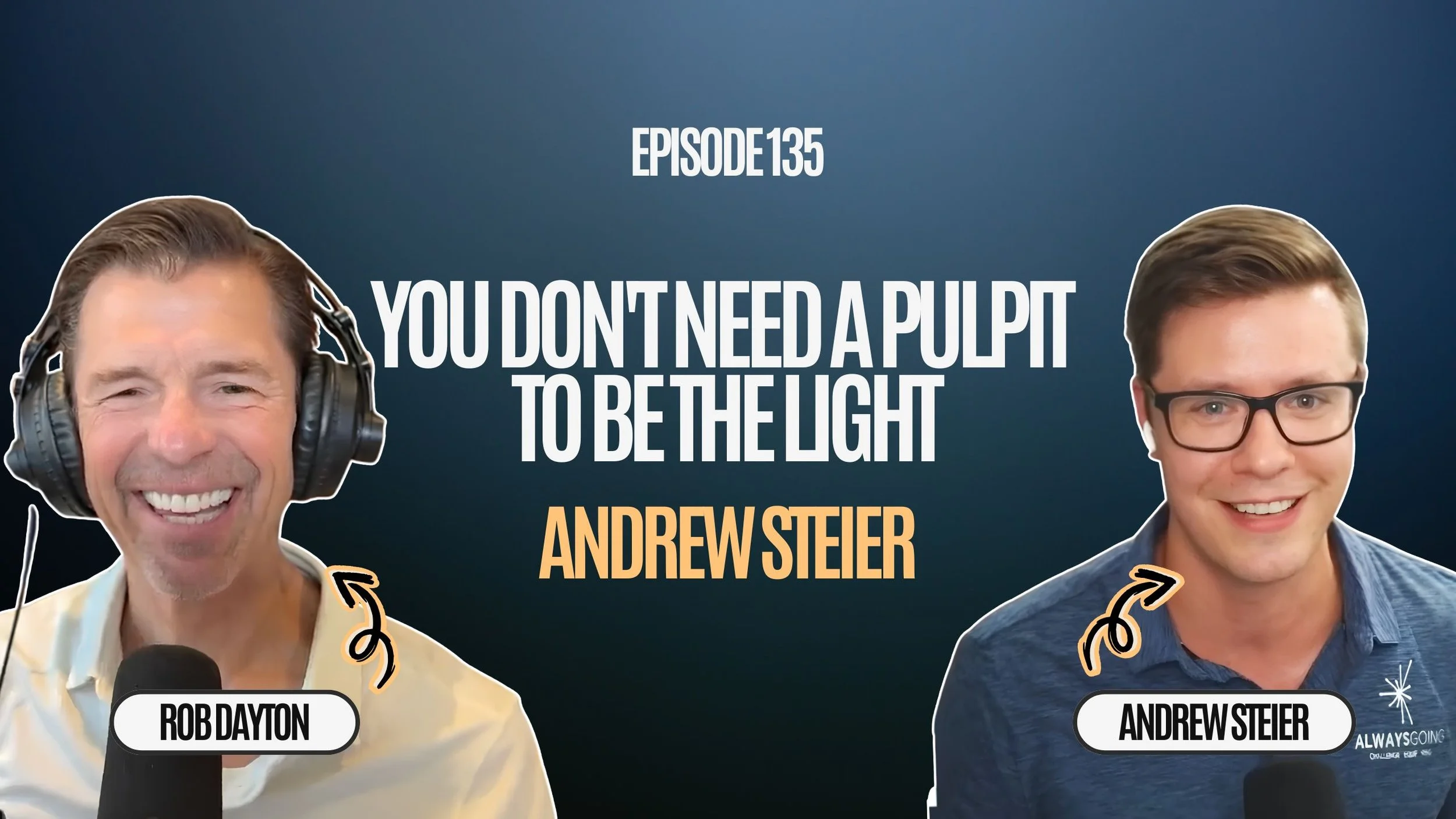
In this episode of the 100xLife Podcast, Rob Dayton sits down with Andrew Steier, founder of Always Going, an evangelism ministry built around one simple but radical idea: you don't have to bring a pulpit into everyday life to be a light in it. Andrew calls it overflow evangelism, the practice of loving God so fully that love naturally spills out into ordinary moments, whether that's the grocery store, the mall, or a Sunday morning at church.
Rob and Andrew dig into why so many Christians live like they're avoiding a cosmic kill joy rather than walking in the freedom Jesus actually offers. They talk about calibration, the daily practice of returning to God's truth instead of drifting into old patterns, and why self-denial, done rightly, doesn't cost us anything. It fills us.
This conversation also gets personal. Rob opens up about his own struggle to find joy in church, and Andrew walks him through a reframe that applies far beyond Sunday mornings: church isn't a place to be served. It's a place to practice.
If you've ever caught yourself judging a stranger, feeling drained by community instead of filled by it, or wondering how to actually live out your faith in the mundane moments of an ordinary day, this episode offers a practical, hopeful way forward.
You'll Hear
What overflow evangelism means and why it starts with loving God first, not serving others first
Why self-denial, rightly understood, is freedom rather than sacrifice
How to use everyday errands like grocery shopping as a training ground for love
Why paying attention to the stories you tell about strangers reveals the condition of your own heart
How Andrew coaches his own kids through hard decisions using peace as the measure of the right choice
Why church attendance often defaults to consuming instead of contributing
How practicing mercy, patience, and grace inside the church prepares you to extend it everywhere else
A simple, honest journal prompt for uncovering your own default posture toward people
Journal Prompt
Sit somewhere with a lot of people around you. What stories are you automatically writing about them? Are they stories of love, or stories of judgment?
About Andrew Steier
Andrew is the founder of Always Going, a ministry that equips believers, leaders, and churches to live on mission and share the gospel with confidence in everyday life. Through workshops, church partnerships, and speaking, Andrew helps Christians move from feeling like evangelism is an obligation to experiencing it as a natural overflow of their relationship with God.
🌐 Always Going Ministry → https://alwaysgoing.org
📘 Always Going Book → https://alwaysgoing.org/product/alwaysgoingbook/
-
Welcome to the 100X Life Podcast, where we activate people who desire to live the words of Jesus and experience the abundant life He promises. I'm your host, Rob Dayton, and I hope this podcast inspires you to put in the work of following Jesus.
Rob Dayton (00:36)
Hey 100x lifers, welcome back to the podcast. I hope you've enjoyed your week. We have a very special guest with us, Andrew Steyer, who has an a brilliant ministry that's actually having you be the light of the world and having people experience you in your just everyday practical life. I would say, Andrew, for you and me, the common theme.
That I would say is very unusual as we both see practicing in the grocery store. That's it. As a playground. It's an opportunity. It's like it's the best place. And I want to talk to you about that. But he has a a really, really good book that you should read, always going, it talking and really helping us to be practical in how we show up. And you know, I want to, you know, hear this more from you as like being evangelist, being an evangelist.
But not necessarily bringing a pulpit to the grocery store, but being an evangelist in the way you live and show up in everyday life. Welcome to the podcast, Andrew.
Andrew Steier (01:34)
Hey, thanks, Rob. I'm I'm excited. I everything that you teach and do in your book, it's it's been really cool to look through and just go, yes, yes, yes, yes. Like if only we did this, it would be awesome. and so I'm happy to be here.
Rob Dayton (01:48)
So good. Well welcome. And you know, the trick of that is, and I think that this is maybe this is where we start, because the way you occur to me as a person who who their purpose or that one of the outcomes and you confirm if it's true, is that you want to see transformation in a life. You're not just talking about the transformation of of the person that you're in front of, but personal transformation that actually gets the transformation of the other person.
Andrew Steier (02:11)
Yeah. Yeah, it's that's exactly it. I mean, God has called us to enjoy this life with him. Like ultimately, we're gonna be with him one day in heaven. That's ultimate goal. That's how he created people was to be with him in the end. He'll be with us again. But there's this middle part that I think so many people are just trying to make it through or figure out how to keep him as
the least bit mad at them as they navigate through this life. And it's like you're missing out on the joy. And specifically in in all was going, it's like with the Great Commission, so many people see it as a job. And I'm like, no, this is a joy. It's not an expectation, it's an invitation. God's God's inviting you into something, and you're going to love it if you understand it correctly and walk, walk in it rightly. And so I just love helping reframe people because it just sets them free.
They're stuck in an ideology that God's mad and tapping his foot and I like to introduce them afresh to their good father.
Rob Dayton (03:11)
So good. And it's and it really is a mindset shift. And so you and I are very similar. We're looking for transformation, which is a mindset shift. And particularly the one you're talking about, which has been so frustrating for me in what I call churchianity, is this thought that you know, God's more of a cosmic killjoy, he's got all these rules for me, and then I've got to show up in them, and then I'm frustrated with other people not following the rules, and I'm frustrated with myself not following the rules, versus this mindset shift that the way I'm hearing.
From you is, hey, Jesus has called us to the abundant life. This is a this is a really good thing. This side of heaven, it could be really, really good. Jesus is not just talking about eternity, he's talking about now. Yeah. And actually, you know, if we take the fruits of the Spirit, which, you know, I would argue dwells in us because the Trinity dwells in us, and really say, hey, we've got something good to express.
Andrew Steier (04:01)
Yeah, it you see the word behind me. It's the crux of everything that I teach. I call it overflow evangelism.
And it's just this idea that you were called to love the Lord your God with all your heart, mind, soul, and strength First. So many people are like, All right, I'm a Christian, I have all of this to do. And it's like, no, no, no, hold on. You were called to love him with everything that you have and everything that you are, just every part of you. And as you do that, you will naturally fill. Draw near to me and draw near to him, and he will draw near to us, right? Like there's so much in the Bible about when we actually approach God for God.
We are filled rather than trying to check things off a list or anything like that. That's that abundant life. It's proximity and intimacy with God that fills us up. And then as a natural occurrence of drawing close to God, we will then overflow
And it's not a fill and then go do a bunch of stuff to empty yourself again. It is a remaining perpetually pursuing him. And then as you go to the grocery store, like we just said, you will be producing the fruit of the spirit, right? As we walk with him, we will produce. And that's where we love our neighbor as ourselves. And I would argue, go make disciples. But Jesus said before he ever said,
To to go and make disciples, he said, follow me and I will make you fishers of men. It was, it was follow me first. And then as you learn how to follow me, eventually I'm gonna be able to tell you, okay, now you can go do the thing because you know what it's like and I'll be with you.
Rob Dayton (05:30)
Missed
it. You've been you've incorporated into your life. You know, we've been talking about on the podcast recently about and it actually came because I was just hanging out with Jesus as you said, like I was I was making sure I'm I'm always full and flowing over. and the question I asked Jesus was I was kind of frustrated with the triune bean concept and like here we we're you know, as Paul would say, we're divided. Sometimes we're focused on the body, sometimes we're focused on the spirit with our minds and then
you've got these three in play and i was kind of frustrated with and i just said jesus why did you create it this way like why did you do that and i'm very interested in in your your thoughts on what i heard at least what i i really believe i heard is and he took me on this journey he's like rob every single thing that i've created in this thing called planet earth universe triune being the creation of time
And age which are not in eternity, the the creation of marriage, not in eternity, the creation of procreation, not in eternity. It's here, it's designed for here. He says, every single thing that I've designed is the perfect cultivation of love. And and and I've given you the I've given you the capacity to not choose love, but I've also created the best environment for you to choose love and to practice love. How does that hit you?
Does that resonate with you? I and be as critical as you want.
Andrew Steier (06:46)
Yeah, no, I mean, I do a lot of talking with people about the heart and the intention of God because we have a tendency to create our own caricature of who God is. And we'll even use the Bible to do it. We just will pick and choose and we'll read things out of context and and we'll then take our experiences and shove them into the equation and we create this character caricature of God. And so I do a lot of like correcting. This is what God intended.
And you can see it here, here, and here. And this is the the way that he treated his people when they were doing this. And it all is just rooted in this intimacy with him, an understanding of his heart, and then a walking his way. I was talking recently about our need to calibrate to the will of God and the way of God. You can't just do one of the two, like what God wants, how he wants it. And to your point, it's always going to culminate in perfect love. Like it just
It always will because he is love. And he's a lot of other things. He's a lot of other things too. And so it's a it's a very full picture, but he will never lead us to do, say, be a thing that the ultimate purpose is not to draw people to himself. Like and so we spend a lot of time trying to come up with.
Reasons why God wants us to cut that person off or why God wants us to do this or this. And it's like, no, he wants restoration. He wants, he wants reconciliation. He's gonna make all things new again. And we get to play a small part in that while we're on this earth as his ambassadors, as a royal priesthood, as his light. Like the Bible's absolutely full of descriptors of how we help people understand the love of God.
Rob Dayton (08:29)
Mm.
That's so good. And and some of the things that that are helpful for me is to like in and bring them to God. Another way of saying it is bring them into love. You know, not that you would you would not say God, but I'm just, you know, further clarification. Here's what I'm inviting you into. Yeah. Is I'm inviting you into love. And and that so the with that kind of framing of the purpose of creation is to cultivate love. Then the question for us becomes, and I think that this fits with where you're going.
Is how do I expand my capacity to love? How do I do that? And like in like everyday life, if my if the purpose of God's creation is for me to cultivate love, how do I do that? How do I expand my capacity to love? Like, what is your first thought on that?
Andrew Steier (09:14)
First
John four nineteen. Like we love because he first loved us. Like that's that has to
Rob Dayton (09:19)
Experience
God's love. And that that's kind of your filling station. Yeah. Go be filled with his love so that we can love.
Andrew Steier (09:27)
It has to be the bedrock because there's no reason outside of him that I would ever love my enemy. Like it's not pragmatic to me to love my enemy. And so if I'm given the choice, if it's me and even on my very best day, my very best day. It's like how Romans, Romans talks about like for a good person, maybe you might dare to die.
But God demonstrates his own love and that while we were still sinners, Christ died for us. And
Rob Dayton (09:55)
Yeah.
Andrew Steier (09:55)
yeah, that's what we are called to model, and we won't do it in our own strength. And so as we have intimacy with Jesus, we have to calibrate to his truth again and again and again. And like in our ministry, we we talk a lot about calibrating to the truth of the gospel every single day. Like it has to be, if you're gonna think about evangelism, you need to be.
Dipping in and out of the gospel about yourself in your own mind, calibrating to it. And so much of that is this irrational love of God. We will never extend irrational love if we do not first experience irrational love and then calibrate to it because it it dulls over time. You know, you spend a lot of years with Jesus, and then you go to my mom used to direct the Easter cantatas, the Good Friday cantatas at our church up in North Dakota.
And it's like, yeah, no, okay. Well, yep, Jesus died and you go a few years and it's like it it lessens in its intensity and its weight.
Rob Dayton (10:56)
You just be it just becomes so normal you're not in awe anymore.
Andrew Steier (10:59)
And yeah, so how do we before we can practice it, we must be in awe of it on on our behalf every single day. and and that that increases our capacity to extend it and and our desire to extend it.
Rob Dayton (11:13)
I'm curious. I'm curious what your thought is about when you say calibrate, I would say the hundred the practice of a hundred X life in that word would mean we have this triune being our spirit, which is completely for perfected, seated in heavenly places, Ephesians 2, 6. And then we have our soul, which is our mind will of emotion. The mind is the conscious seat of choice that can choose to love or not to love. And then you've got this brain, which is a part of the body.
That is programmed almost fully to at age five and seven, mostly with things that are not helpful. The calibration you're saying, what comes to my my mind is we need to get in sync, have the spirit and the mind and the brain reprogrammed neural neurologically to automatically love. Does that resonate with you? How would you shape how someone would do that?
Andrew Steier (12:01)
it's so much of what you do. It's the it's the habits, it's the regular daily life. Like we have to Paul Paul says, I beat my body into submission. It's like that's what it feels like sometimes, but we have to beat our mind into submission too. Like we're calibrating to something. And so calibration must mean a denial of self because we are not the thing that is being calibrated to.
every single time we're the offshoot. If we believe that the Lord has has a will and a way, and it's laid out in scripture and come perfectly consistent with the spirit of God living in us, when Paul says things like keep in step with the spirit, it's
Rob Dayton (12:41)
Yeah.
Andrew Steier (12:42)
you take wherever you're going and calibrate back. You don't tell the spirit to come over and follow you, you deny yourself in these ways. And that's a
Theme all throughout scripture. And so, so I think when it comes to the different faculties that we have, as human beings, we are very pattern driven things. And we can use that to our benefit. That there are patterns, there are rhythms, there are habits that we can begin to form that don't have to be legalistic, right? Like I have rhythms with my wife, I would never consider them legalism.
Because they are rhythms of I love you, right? I'm going to hug and kiss her before I leave the house.
Rob Dayton (13:21)
And it's unique to you and your spouse.
Andrew Steier (13:23)
Exactly. And and and those rhythms, they're not a burden or a chain to me. And that's where I think so many people kind of kind of get mixed up here. Is there like I gotta follow a bunch of rules and do a bunch of things. Well, no, no, you get to.
Rob Dayton (13:36)
That yeah, that's so true. That's so true. And you know, and even in our conversation I've I see like the where people do the missteps, like self denial,
Sounds like a sacrifice. And I think if we were, if we had Jesus on the podcast, he's right. man, wouldn't that be amazing? my gosh. and he would probably be saying, Well, actually, self-denial is abundant life. Like you want the best life, practice self-denial. You want the best life possible? Practice loving your enemies.
This is just what love does. And and your best life is always what I've created you to be, which is love. Does it does it d does that clarify it for the people who are kind of making the missteps in your brain, or is there a different way?
Andrew Steier (14:18)
Yeah, there's a very pastoral conversation to be had with people in that. I think that's a pivotal conversation for a lot of people. I think it's a a turning point for a lot of folks. I think of like Psalm 23, his rod and his staff, they comfort me. It's like that. We don't what do you mean the rod and the staff comfort you? And you actually help.
Someone understand that it's it's a a slow guidance. And it's like when I feel that rod or staff on on the back of the sheep saying, just go forward, don't go to the right, don't go to the left. I'm here. I've got you. We can walk through the valley of the shadow of death. So you take people who have attributed to God something that he is not, and that's like a taskmaster. And so obedience feels restricting, but it's like.
Then you walk with them through some of the things that they're going through in their lives. And it's like, isn't it good to know that you have a good shepherd guy like leading and guiding you? And that every once in a while he's he's he's tapping you back to center so that you can walk through this thing. So it's like it's this pastoral conversation that has to happen with folks as we gently introduce them to the God of love, who is still a God of discipline and is still a God of justice, but it's perfect love.
Perfect discipline, perfect justice. So again, it's that reframing. And once you understand him to be that, like once you understand this about him, then denial of self becomes freedom. I am so much more free knowing where my boundaries are. It's like we used to live in a neighborhood that backed right up to the interstate.
And for some reason they put up this big wall between the cars on the interstate and people's backyards. For some for some like, how restricting is that? What shouldn't we just let the kids run out back and play wherever they want? It's like, no, freedom is knowing that there's a boundary that will protect me. And and so it's one of my favorite things to see a new or interested believer come to realize is everything they thought about Christianity actually.
Is the opposite.
Rob Dayton (16:21)
It's it's totally what in my experience too. And even as you're talking to him thinking, my yoke is easy, my burden is light. You know, like he's it's it's not a yoke of constraint, it's a yoke of freedom, you know. Know the truth and the truth will set you free. how do you like how do you go about helping someone think through that process and and transform? Because you know, a lot of us have grown up.
with these false beliefs about who God is, what is our purpose here. you know, many of us are just ignoring eternity. You know, we we all want to go to heaven, but we don't want to die to get there. Yeah. You know, like it's just this, it's this conundrum. How do you walk someone through that to actually transform the way they think?
Andrew Steier (17:03)
It's so unique depending on how long the person's been on earth. Because the longer someone's been on earth, the easier it I say easier, but like the more data we have to pull from that their way is not working. And I get the opportunity to go out to Sawgrass Country Club where they do the big TPC golf tournament. nationwide. Yeah. So I'm one of the two pastors that preaches in the country club.
To a group of eighty to a hundred retired folks and we're right there on the beach. My
Rob Dayton (17:33)
My favorite place to preach is the country club.
Andrew Steier (17:35)
It's it's incredible.
Rob Dayton (17:37)
Why?
Andrew Steier (17:38)
They've been they've been meeting there for 40 some years, and the wealth of experience that they have makes them so much more willing to be shepherded and pastored because they think back and they're like, well, my way certainly isn't working. Now, obviously, long life can make folks stubborn, but at least it gives me a launching point to say, like, yeah, look at these decisions versus how they should have gone.
Like what God's word has to say about them. Imagine how they would have gone differently had we just calibrated to God's word. So I I think it does depend based on how old the person is. I also work with a lot of teenagers and they everything has
Rob Dayton (18:15)
Everyone
Andrew Steier (18:16)
gone great according to them. You know, even the bad stuff has been great because it, you know, it's just experience and and that I I really have to point to
what comes as a result of doing it their way versus doing it God's way. And the peace of God that transcends all understanding is the number one thing that I'll point to. And and I didn't supply
Rob Dayton (18:37)
That how tell me how that's the keystone for that transition.
Andrew Steier (18:40)
Right. I'll I'll talk about my own kids. I have an 11-year-old and a 13-year-old. My 13-year-old has really taken to a parenting strategy that sees a poor decision coming. And I put my hands out like this. And I and and she she wants me to do this. She's asked me to do this. I did it a couple of times. And now she's like, Can you please do it? And I'll say, okay, this is where you're going.
And here are the consequences of that short term, and here are the consequences of that long term. Now you can choose this one. I will go down this path with you, I promise. And I love you. We can do this if you want. Or you can pick this one. And you can't see this one as clearly. but here are the short-term consequences. They're gonna sting a little bit, but here are the long-term consequences of choosing the way of the Lord. And I just let her pick and seeing the two paths.
In front of her clarifies something. It didn't at first, but then she chose this one a couple of times, and then she chose this one a couple of times in situations. And we would talk about where is your heart? How is peace? How is you how are you having peace? Like you chose God's way and you got disciplined. You got consequences. And any kid would tell you, that's not peace, but you actually felt.
The peace of God because we did it his way. And so it's just this like slow, painful, experiential process that we're paying close attention to our hearts and our minds throughout the process. And then we're looking back on it after we've gone through it either way, you know. And I've done that with with young people in both areas, where it's like a teenager will pick their own way and we we look back on it. I'm like, you know, I love you.
You know I love you. I'm not criticizing you, but do you see how much pain that you brought into your life? How much pain you caused this other person? If you could go back, would you choose differently? And that's typically pretty helpful in talking to young people.
Rob Dayton (20:30)
It's so powerful because you're I love that with particularly with your daughter, you're saying, Hey, you choose this way that maybe is you we would characterize as not the abundant life path. I'm still gonna be with you. I'm still gonna walk this with you. Whereas so many of us think that
And this is what we do, this is how we how I know we feel this way, is that if if we're not doing it God's way, then somehow his love is being cut off from us.
And I love that you're teaching your daughter, no, you, you know, there's a you're not saying this, but there's a cross. and what makes this logical is I'm a parent and you're my offspring, and I'm go always going to be for you. There's no cutoff of love here. You get to make your choice, and I don't cut off love. I think that that perhaps is that's the nuclear.
part of your transformation process. And I feel like that really is like is really like Christ that he, you know, as you brought brought up, he while we were still his enemies, he died for us. And and it and he, I think that the reason he does that is he's faithful, which means he believes in us so strongly, which is what you're saying to your daughter, I believe in you so strongly. You could choose the way that dad wouldn't do it.
And I'm still here. I'm not withholding love. We're just the experiment is just about which one's bringing you the abundant life.
Andrew Steier (21:51)
Yeah, and and I think of first John chapter one and two, it says like you are not what you do. And and I'll explain that's something that I've tried to tell her. Like, you are my daughter, and here is what is true about your identity.
Rob Dayton (22:07)
This is who you are.
Andrew Steier (22:09)
This is who you are. When you choose the wrong thing, I'm gonna help pick you up. It's just like like John.
Rob Dayton (22:14)
It
doesn't change your identity. Which is your point, is that what you do is not your identity.
Andrew Steier (22:18)
Yeah, the difference between someone who's not my child and my child is that I am invested and involved with you. Like I'm not I'm not worried about that other kid. They're not my responsibility. I'm not gonna correct them. I'm not gonna discipline them in the same way that I am you because you are mine.
And this is coming from a place of love, right? Like John says, you are going to sin. If anyone says that they have no sin, they're a liar and the truth of God is not in them. So it's like you are imperfect. And then he goes on to say that that you are invited to confess. And when we do confess, we're, you know, he's faithful and just to forgive us our sin. And then we're instructed. I write this to you so that you will not sin. And then we're imputed the righteousness of Christ because
Yeah, he goes on to say that that but when you do sin, right? Like so so you will sin and you do sin. You can come to me with that sin, do everything you can to not sin, but when you do, I am still here with you. And it's
Rob Dayton (23:14)
It's
such a balance. It's such a balance because good because you know, I don't know what it was like for you, but I was told, at least maybe I wasn't told. I don't I don't want to blame other people. I I felt as though I was a slave to sin. Yeah. And the and you know, in the in the the passage you're pointing out in First John, you know, it's it's a little bit more complicated than that.
Andrew Steier (23:34)
Yeah.
Rob Dayton (23:34)
It could be an either or and let's how do we get to this place where you're a slave to righteousness in in the area where you're transformed? I
I want to get to another thing that John writes is which is profound, which is like and then and then tee it up for a question. So he says, if you can't love your neighbor, you can't love your brother, then you don't love God. Like in other words, our love for each other is a demonstration of our love for God. How does that for you show up in the grocery store? Let's go there. Like, what does that look like? Because, you know, for me, I'm just
I'm trying to treat the grocery store not as more fun because I just just to you know and my listeners probably know this, but like I I don't like having a list and going in a grocery store or Costco. It drives me crazy because I'm not good at it. I I I I kind of am a visual guy. I don't remember where everything is. I'm constantly leaving my cart and then, you know.
Going back, and then I figure, I should have brought the cart because now I'm carrying too much back. And I'm just, you know, I'm just so frustrated. And now I'm like, okay, not only will I love this, I'm gonna go the opposite direction of everyone in Costco for the purpose of actually becoming face to face and enjoying people and seeing their face and what they're doing and loving them well. and that is where I'm going. How is it for you? What is the mindset?
Of loving others that you enter the grocery store with that changes everything.
Andrew Steier (24:56)
Yeah, it it is absolutely a a preparation of the heart and the mind that leads to action. We don't accidentally care about people. We just don't. That's not how we're wired. We care about ourselves. and so just like you said, I like to go the opposite way. You prepared in your mind and your heart for a purpose, and your action actually flowed from that. And then you have opportunity that follows your action. But none of it happens without preparation.
Okay. Wow. So that's where it starts. And I like to think of this as you know, there are people everywhere. I use the grocery store because I find myself there so often. It's right, it's right down the street.
Rob Dayton (25:36)
So sorry.
Andrew Steier (25:37)
I've the worst place to live. Like I grew up forty minutes from a grocery store, so I didn't have to worry about it. But now it's like two minutes away and too convenient. But anyway, I find myself
Rob Dayton (25:46)
You can
forget stuff and then have to go back because it's it's not as painful and so you don't learn the lesson.
Andrew Steier (25:52)
And then when you go back, you always pick up something extra and you know, all that. So there are people everywhere. You know, I live in Jacksonville, Florida, you know, a couple hours from from Orlando, there's Disney, there's malls, there's all of these places. And first of all, regarding love, if you want to know the default state of your heart, I always encourage people to go sit on a bench at Disney, go to a mall and just watch people and pay attention to your heart. Is your heart leading you?
Because people are weird, man. People are weird. And you will, if your heart is not in a place of calibration with Christ's heart, you will judge them. Because they're not making it hard. They're wearing all kinds of things. They're doing all kinds of things. This is the world being the world. It's just people being people. And so if you want to know where your heart is, just baseline, go and watch people and pay attention. But then they're
Rob Dayton (26:45)
Pay attention
to specifically would you how would you describe that? your heart, your heart's condition is that like the pay attention to the stories that are arising within you.
Andrew Steier (26:54)
Pay attention to how you maybe I should say the stories that you are writing about people. So you
Rob Dayton (26:59)
Yeah.
Andrew Steier (27:00)
see someone and they're they're not disciplining their kid the way that you would, and all immediately your heart becomes critical. Or you see someone and they don't look like some they don't look or dress or or anything, and immediately your heart becomes judgmental. Like pay attention. Or you could see someone and your heart be filled. You see a parent and a child and your heart is filled with compassion.
So this can go either way. We just
Rob Dayton (27:22)
Yeah.
Andrew Steier (27:23)
need a barometer. We need to be able to measure.
Rob Dayton (27:26)
are kind of our default. I love the f the words you're using, you're choosing, are is what story are you writing about people? And then you can evaluate the story. Is this is this a story that Jesus would write about people?
Andrew Steier (27:38)
Yeah. And most of the time we have an interaction of Jesus and an individual that is described in a way that we could, you know
There wouldn't be exactly the same, but it would be close, right? The woman caught in adultery or the judgmental Pharisees or the the little children with the you know, people saying, Go away, go away. Like there's all kinds of stuff. So anyway, all of that to say that we need to pay attention to our heart. So when I'm going to the grocery store, I either I have two modes. My first mode is that I put these in and I just ignore everyone. Podcast. Right. It's I'm doing my own thing. You may as well all be
robots for all that I'm concerned. Mm-hmm. And
Rob Dayton (28:18)
Or even obstacles.
Andrew Steier (28:20)
that is absolutely a selfish desire of mine to not overflow, to not engage in the abundant life, to go do my thing, get home back to where I am comfortable, where it is convenient for me to be a Christian, in my home, at my church, right? Not out in the world. Come on.
So that's that's if I'm not preparing my if I'm not preparing my heart and mind, that's where I end up. It's just by default. That's where most people end up. But there's something completely different when I'm driving into the parking lot and I see you know a mom and she's unloading her cart, and I just sit in my car for an extra 30 seconds so that I can exit my car when she needs to bring her cart back, but she's got a kid that she's already loaded in her car. And it's like,
I'm doing it on purpose. Like I'm I'm on a mission. Sure, I'm coming to get ice cream. That's let's be honest, that's mostly what I'm out there for. But like I am trying to be Jesus in these small ways. I'm not trying to stop everything and proclaim the gospel in every situation. Yeah. But I'm I'm almost training myself to view people like Christ. And it's it's a it's a surrender. It
Rob Dayton (29:30)
It's the calibration.
Andrew Steier (29:32)
is it's a surrender. I'm gonna surrender.
My quick trip, I'm gonna surrender those extra 30 seconds. And it's just a ton of tiny little sacrifices that make me leave the grocery store having a great having had a great conversation with somebody, having encouraged somebody, smiled at about as many people as I could, maybe buying something for somebody. And it's like I'm leaving knowing that this is what it's like to walk in the spirit, and I'm just full. Like it, that's the thing.
We think surrender will cost us, but surrender fills us. And and the quicker that we figure that out, the more the more we will want to surrender. It's it's a it's an incentive to surrender once we figure it out. So that's kind of my mindset.
Rob Dayton (30:17)
Love
that, and that that tracks with last week we were talking about the the statement, the simple statement, everything I'm experiencing, I'm creating. Which is you know, you're and you're you're saying that like it's just taking responsibility for your own experience. I think we get fooled into thinking.
that everyone else is creating an experience for us. You know, I'm picturing me in Costco. It's you know, like they're in my way. They're, you know, I I they're not helping me really figure out this this place where I'm stressed out. You know, you're you know really you're you're you're gonna leave your cart right there in the middle of the aisle. Really? You know, just an obstacle standpoint. And then I leave feeling exhausted
Frustrated, stressed, I'll never come back here again, versus just seeing this as an opportunity to express love. You're saying be Christ-like, maybe another way would be to say be love like, which is Christ, and just and just indulge in giving out love. And then you leave the the parking lot going, wow, that was kind of cool.
That was I that you do, like you said, it's full.
Andrew Steier (31:26)
You see what God meant. Like, like, that's it. Now, like, imagine and then and then we go away and like convince ourselves otherwise 20 minutes later. But it's like, imagine imagine just like 30% of the people in the grocery store thinking that way at any one time. It would feel like chick it would feel like chick.
Rob Dayton (31:44)
Unbelievable.
It was if you go there. I just like that 30%, that would blow my mind. I mean, that would make that would if like 30% was happening in no other place but Costco, that would become one of my favorite places to go. Because we're
Andrew Steier (32:02)
Yeah. And and because
Rob Dayton (32:04)
experiencing love.
Andrew Steier (32:05)
let me say something, I don't know if it's controversial.
Rob Dayton (32:08)
It's got I love controversy.
Andrew Steier (32:10)
Do you think that thirty percent of the people in any given church on a Sunday morning are acting that way? No. No so this is not just this is not just out there in the world. This is like people
Rob Dayton (32:21)
And why didn't
Andrew Steier (32:22)
not why do people not want to come back to church?
Because everyone sees every I shouldn't say everyone, because it's easy to have that same obstacle mindset and be like, I'm here to get my worship. Like I'm here to praise my Jesus. You're sitting in my seat, you're parked in my spot. You just took the last of the coffee. But it's it's a mindset that if we adopt this, it is not about me, even my Sunday morning experience. I mean, ultimately, it's all about him anyway. Him.
them then me.
Rob Dayton (32:53)
Yeah.
Andrew Steier (32:54)
And and that's what it's like to walk in this. And so I I do some church consulting and things like that. And what I like to to challenge them with is I have a definition kind of of of a bunch of metrics of what it looks like to be an overflowing Christian. I basically just made the perfect Christian, right? Like it was like, what if they could do this? What if they could do this? And it's just a totally fictional person. and I ask them like
How many people in your church do you think are even sniffing at this? Right. Like can and some of
Rob Dayton (33:24)
The answer is
Andrew Steier (33:26)
a lot of times it's a very few. They've been put in like high positions of leadership. They're not just normal people. As soon as
Rob Dayton (33:34)
So
I can't be like them because they're in these high positions.
Andrew Steier (33:37)
Well, that's a staff member. that's an elder. that's a ministry leader. It's not just like Susan, who's got three kids under three, and she shows up. But every time you're around Susan, it's just infectious because she's just Jesus to her kids, to everyone else. It's like, okay, so then we we try to help that church figure out, well, what percentage of your church would you like to be like this? And now we can actually build some steps to how do we help? How how can we help?
but it's amazing. We we think that churches have nailed this and we just we have
Rob Dayton (34:09)
Okay, so let's turn this into a counseling session for Rob. And because you you've touched on a place that I still am not experiencing joy. And that is going to church. So when when we were in Santa Barbara, we had our own ministry. we didn't call it a church, but it functioned much like a church. And we did that for
twelve, thirteen, fourteen years and then we moved to Bend last year and we try you know, like we wanna be in community with people. we do have an a lot of people we already know here, but then you know, we wanna, you know, be in the community. So where do you find that? Church.
So we've been going to church and then, but then the same conversation we're having about what love really is, about overcoming this cosmic killjoy thing, or that somehow denying yourself isn't the best thing for us. I'm hearing the messages and cues that beat down the our message that we're trying to convey, and it's so discouraging. And I find myself
You know, judgmental of the teaching, or you know, one church we were in, it's like no one even responded to the to the worship, it was just so dead, or you know, people being fake, or their biggest concern is how often do you go here and when are you coming back? And so help me out, give me the mindset for Rob that is gonna find joy in that place.
Andrew Steier (35:27)
I think it's just as a joy bringer. Like you go to the grocery store and you don't expect everyone to fall over themselves to serve you, but it's in the preparation in heart, mind, and spirit, knowing that church is not this magical place that that doles out whatever it is that we want.
Like I've I've experienced this too. I'll go to places and I I end up attending various churches because of the ministry and and things like that. And I'll go and I'm like, do any of you wanna be here? Like anybody? Does anyone want to be here at all? you know, like I'm not the most expressive worshiper. And I visited a church recently and I was the most expressive worshiper in the room. And I'm like, something's broken, right? Like, I don't get it.
And so I think that there is with with with a voice, a platform, a calling that you have, voice platform calling that I have, like we know that we need to be in community. And I have solid community, regardless of the church that I'm in. I have solid church community with my brothers and sisters in Christ outside of a Sunday morning. And I think that is that's absolutely
Rob Dayton (36:36)
Title.
Andrew Steier (36:37)
we will play board games.
We will you know, go to sports events and things like that. It will meet up at a pizza place. And I'm just my soul, my spirit, they're encouraged in the Lord. They're built up by these people. No one's preaching a sermon. So that's that's number one. but when I have a relationship with the Lord and I have an ideology and a worldview that this is how it's supposed to be, and I'm actually walking in that. When I walk into church, like
It's not a burden for me to be kind of a joy bringer. it's it's it's fun for me. Where I'll challenge I'll challenge some people and and yeah, there there's so much laying down of our preferences and how we would do it. because someone will preach a sermon and I'm like, oof, I would have done it differently. Or maybe even I have done it differently. I preach a lot. So it's like we have to s we have to surrender that stuff. But it's like, who's the who are the one or two people?
That I can just like spark a little joy in every once in a while.
Rob Dayton (37:35)
Be the be the joy bringer. Yeah, I love that's a great mindset. And then well and I will say when I visit a church, whether I'm speaking or not, my mindset is fully that. It's almost like the impediment is it's the courting, you know, like is this the church I'm going to commit to? Right.
And I'm like, you know, we we dro we drove away and it's so funny because Nancy, my wife, said something similar to you, like, well, this is this was the the no no joy in worship prowl that we went to. And she said, Well, maybe, maybe it's it's our role to bring the joy to this church and get the fire started. And I and I was like almost violent. I said, Well, God's gotta tell me to do that.
I don't want to do that. So it's almost like there's this, there's this huge mindset. I think maybe I just need to, maybe I need to ask the Trinity is like, do you how important is this for me to grow love, my capacity to love? And and is this gonna be the gym that I'm looking for that would really exercise my capacity to grow love?
Andrew Steier (38:37)
I I would maybe press into that a little bit. You would probably say the same thing as me that anywhere else in our lives, we would happily take on that role. Anywhere else. Like 30
Rob Dayton (38:47)
Yes.
Andrew Steier (38:51)
feet, 30 feet from the church, we would take on that role and we would love it. And it wouldn't tire us out and it would fill us up because we do know the
Rob Dayton (39:00)
We create energy. We create energy from that.
Andrew Steier (39:02)
We know the calling that we have. Yeah. And so to walk in that calling, just this thing happens when I think the mindset can shift where it's like final. I'm at church. Man, this is for me to fill up. You know, it's and so everything shifts where it's like, well, I am I willing to bring it to this place. It's like this should be the easiest place to bring it, regardless of you know what's what's kind of going going on in
You know, as far as any everything's doctrinally sound and that's that stuff's important, but like if it's a a preference thing or if it's a you know, we gotta see the church as a bunch of people that need encouragement. That's the one thing. Like, I work in an evangelistic ministry, and everyone's like, non-Christians need the gospel. Non-Christians, and I'm like, Yes, they do. They 100% do. You know who else needs the gospel? Christians. They need it desperately. Because
In order to live an abundant life, in order to walk in overflow, pick your analogy, they need the gospel on repeat because of how easy it is to forget where all of this is stemming from. And so I tell people, they're like, I don't know any non-Christians, so I don't share the gospel. And I'm like, fine, pick 10 Christians and go and encourage them and build them up with the gospel and remind them of the gospel. Find someone
Who's a Christian who is stuck in sin, and ask them, what did you forget about the gospel that led you to this place? Let me remind you of our God. Like, and and so I think that there's so much work to be done outside the church in this, and there's so much beautiful work to be done inside the church. It's only when we engage it inside the church that it doesn't just become a production or a show. Right. If everyone's just coming to get something and leave.
Then we've missed the point.
Rob Dayton (40:50)
So we've got it. So I think that this is a huge takeaway is we we've got a we're we're going to church not to be served but to serve. As a as a primary objective, we might be served in that process, but we're our mindset is we're going to serve. We are on mission when we're in the church. And I think you know, you and I probably feel equally strong that the pre-Christian.
will will will take care of themselves if the Christian emanates love. That becomes attractive. You know, we are the repu I like to say we're the reputation of Jesus. We're
Andrew Steier (41:23)
Yeah, that's good.
Rob Dayton (41:24)
the body of Christ. And so you know we can we know how we're doing as a body of Christ
Based on how the world sees us. Do they see us as the the the lovers, the the people who are all the things we're talking about, or do they see us as the the sappers, the takers, and that's how we show up to church? I mean, I confess, like that if if if I'm gonna commit to a church, I'm like, okay, well, what am I gonna get out of this? even if it's what am I gonna get out of this by serving?
Which sounds like I'm serving but n I'm still I'm still taking or expecting something in return.
Andrew Steier (41:56)
Yeah, I mean it it boils down to the the fundamental purpose of the church to equip the saints for the work of the ministry. And I think a lot of our churches have become what is the primary purpose of the church? To make Christians, right? Like to share the gospel with new Christians, not non-Christian. No, no. Yeah.
Rob Dayton (42:13)
Like
Andrew Steier (42:14)
I I had a pastor years ago say the pastor should be the least effective evangelist in the entire church body because he's not focused on that. Sure, the gospel will be a part of sermons.
But you're equipping the saints in the church. And I'm a huge proponent of practice. I'm a huge proponent of like role play. Like, why do we practice everything except our faith? Right. Like we wait until we're around a non-Christian and then we try a new evangelism. but but we practice the church, knowing that we are collectively there to be equipped and sent, should be the easiest place to practice that with one another.
So like if I'm gonna be mercy out there at the grocery store, I better be able to be merciful in the church. And it should be should
Rob Dayton (42:57)
Show.
Andrew Steier (42:58)
be easier in the church than the grocery store.
Rob Dayton (43:00)
Give you the practice you need.
Andrew Steier (43:02)
It should like I need to extend grace and forgiveness. It should be easier with a brother and sister in Christ in the church than it is with somebody who will not apologize and you have to forgive them anyway. So so church is this place where we are served as we practice and we serve one another and we go out from there and overflow into a world that doesn't even know the light at all.
Rob Dayton (43:27)
So good. I love that. So the the the role of the pastor is not the, you know, to teach us how to evangelize. The role of the pastor is to teach us how to overflow. Teach us how to overflow and to stay in that love is just pouring out of us. And I love that you're bringing up practice. Because, you know, like it's really interesting how, you know, Paul says,
in in terms of grace and the influence of Holy Spirit on us, that He desires us to manifest the most, which is prophecy about each other. That's what he's saying, you know, but how would you get there if you didn't practice? You know, if you didn't say, okay, well, hey, this is what Paul wants us to manifest the most of the spirit. Let's practice it and see, you know, we can which means we can get it wrong. Right. And and but we're practicing in a very safe space.
you know, you said practice mercy, practice all these things. Man, wouldn't it change our experience there?
Andrew Steier (44:19)
Yeah, yeah. Especially if you had an understanding that not everyone in the church was good at it already. Which is I think a presupposition that we come in a church
Rob Dayton (44:27)
That they were good at it. Yep. Just because they have the label Christian doesn't mean you're automatically really good at overflow.
Andrew Steier (44:35)
Mm-hmm. Exactly. Yeah. And so so when I'm sitting and talking to churches, I'll sometimes ask them, like, okay, well t talk me through your like either the ministries or the the the things that you prioritize at your church, which of those are filling habits and ministries and stuff? And which of those are flowing? And why is there only one flowing and there's seven people involved and you're going and knocking on doors and everything else is filling? Like, and so so trying to help our churches.
Become balanced in the way that we we train our people and we we encourage them to flow. And I think that there's a flowing that happens from person to person, just exactly like we're talking about. It's like this is an expectation. This is what we do here. It's kind of going back to the identity thing that like God loves us and this is who we are in Him. We're ambassadors. And sometimes the person sitting next to you in church, they need to see Jesus
And you have the opportunity to show him through the way that you extend mercy. it it's fascinating when you get into the whole American church thing, Rob. I it's also super depressing, but there's hope because because the Lord knows what he's doing.
Rob Dayton (45:47)
As it turns out.
Andrew Steier (45:48)
as it turns out, as I'm reminded once every few days here, it turns out he he's pretty good at this.
Rob Dayton (45:55)
So good. Well, this has been an amazing conversation. I would say, and maybe you have something, you know, we we leave something with our listeners to work on to actually do the practice. One of the things I heard in this conversation that I think would be very powerful for you as a listener is to what Andrew said, like go to a place where there's lots of people, sit down with your journal. What are the stories that you're automatically coming up with about these people? Are they stories of love?
Or are they stories of judgment? And you know, maybe they're judgment, no problem. We're we're all in the gym, as as Andrew and I are saying, we're practicing, but becoming aware of the stories we're writing about other people is gonna be huge step for us to understand the something you may not even realize that it's happening to you, that's happening automatically. And once you recognize that it's happening, you can actually start changing the way you think.
And Jesus' repent, change the way you think, and actually start writing some love stories about people. And I'm going to take away, thank you very much, Andrew. I'm going to take away this. I don't know. I don't know if I'm going to commit. but I'm definitely, as as Nancy says, Hey, let's try this church. I'm going to say, okay, I'm here as a joy bomb, which is the total Rob Dayton setup. I'm a I'm a joy bomb always. This is why I'm here.
So if you're interacting with me, you're interacting with Joy, let's go. Any any other thoughts that you think that would be great practices for the people listening?
Andrew Steier (47:21)
Yeah, I I'm a huge proponent of you you can't take a next step until you know where you are. And that's really what what you're saying is go and sit. You just it's
Rob Dayton (47:31)
Find out where you are.
Andrew Steier (47:32)
not condemnation, right? You just need to know where you are. It's like I sometimes hold myself up to the fruits of the spirit and I just say, Am I more loving or am I more hateful recently? It's not an indictment. It's just I need to know where my heart is and where it's been.
It's like a check engine light on a car so that I can address it, so that I can, you know, dive into intimacy with God. So, so I would say, as as far as the calibration and the practice, when it comes to what you have kind of figured out about people and where your heart is, think about how you would engage someone in that state with the good news of Jesus. Like think about it, practice it.
Pretend with somebody. Grab a pastor, grab a spouse, grab your friend, and actually practice it, have real conversations, build neural pathways to get the gospel out of your mouth. Because we can't just, we can't just share the good vibes of Jesus. Like there are there's great joyful vibes that we can have around other people. Like they know when they're around someone who's joyful, it's gotta be accompanied with the truth that can set them free.
Otherwise, they will simply think that they have to conjure that joy through their own goodness or works. We have to tell them that that they're unable to and that they need to repent and turn to Jesus, right? And that can be done in a joyful way. I'm a huge fan of levity. and so so it can be done in a fun way. so we've got resources with our ministry and stuff. We actually are just coming out with a card game called Speak Gospel.
And as far as practice and levity is concerned, it's a deck of 52 two-sided cards. So there's a hundred and four different words that you have to try to get to the gospel message. It's words like corndog and zamboni. And it's such a fun game to play with someone. I do it in my car all the time. I have people in my car, I'm like, you wanna wanna play speak gospel? All right. Your word is Gatorade. How are you gonna get from Gatorade to the gospel? And it's amazing watching people do it.
They're like, wow, we're we're all thirsty and malnourished and and we need the water that will, you know, and they actually get there and it makes it easier. Like, if we want to be overflowing everyday evangelists, we have to practice doing it, not try and practice on non-Christians. And per our conversation, the church is a great place to grab people and practice.
Rob Dayton (49:54)
So good. Where where do they go for that? Is that the alwaysgoing dot org or where where would they get that?
Andrew Steier (50:00)
So our website is alwaysgoing dot org. That will be released in the next month. We have a bunch of other great resources. Got an app coming out at some point soon. but the Speak Gospel card game will be available about within the next month in our online store.
Rob Dayton (50:14)
Okay, awesome. That's so great. Andrew, thank you so much. Really appreciate you taking the time to be with us today.
Andrew Steier (50:22)
Yeah, absolutely. Love to be here.
Rob Dayton (50:23)
So good. Okay, 100X Lipers, we will see you next week. Have a great time.
